
Stage 1 · Research
Researching a Disney World Trip Without Getting Overwhelmed
Where to start, what to ignore, and how to make the first big decisions without disappearing under a pile of tabs, videos, and Facebook advice.
Disney World research can become a full-time job if you let it.
There are videos, blogs, Facebook groups, crowd calendars, restaurant lists, ticket deals, hotel reviews, packing tips, budget warnings, Lightning Lane explainers, and a thousand people telling you that their way is the only sensible way to do it.
The first job is not to know everything; it is to work out what kind of trip your family is trying to have.
That sounds obvious, but it is where a lot of Disney planning goes sideways. A family with toddlers, a family with teenagers, a couple going without children, and a multi-generation family all need different trips. A first-time family trying to see everything will plan differently from a family staying on Disney property for a slower resort-focused holiday.
Research should help you make decisions. It should not leave you with 47 open tabs and no idea what to do next.
Start with your real constraints
Before looking at restaurants, rides, or hotels, start with the things that shape the whole trip.
The big early constraints are usually availability, school holidays, budget, weather, and the pace of the trip.
For us, dates often start with weather. Florida heat and humidity can change the whole feel of a trip, especially if you are travelling with children, older relatives, or anyone who struggles in the heat. A simple monthly Orlando weather chart is useful here because it helps you see the difference between “warm Florida” and “walking around a theme park in August with everyone slowly melting”. WeatherWorld has a useful Orlando climate averages page at https://www.weatherworld.com/climate-averages/fl/orlando.html.
Then budget starts pushing back.
School holidays can cost more. Flights can jump. Accommodation prices shift. Ticket deals appear and disappear. Package holidays can sometimes make the decision easier, especially for a first trip, because flights, hotel, tickets, and sometimes extras are grouped together.
Our early trips were booked through Ocean Florida (https://www.ocean-florida.co.uk), and staying around International Drive, including Rosen Inn at Pointe Orlando (https://www.roseninn9000.com/), gave us good value for money. That sort of trip can make a lot of sense if budget matters and you are happy being off Disney property.
Later trips may look different. Once you know you love Disney and want to go again, staying on property can become more attractive because of Disney transport, convenience, and the feeling of being inside the bubble. It will not suit every budget, but it is worth understanding early.
Decide what the trip is for
Once you know your constraints, turn them into a simple trip brief.
That does not mean one person gets everything they want. It means the shape of the holiday should match the people travelling.
A first trip might be about park days, rope drop, ticking off rides, and seeing as much as possible. There is nothing wrong with that. On a first visit, it is easy to feel you may never come back, so you try to squeeze in Disney, Universal, Kennedy Space Center, shopping, character meals, fireworks, and every headline ride. There is a cost to that approach. You can come home feeling as if you need another holiday.
These days, our trips are more balanced. We still love park days, but we also value resort time, slower mornings, Disney transport, meals, and not treating every day like a military operation. I say that as someone who is naturally quite happy with a plan.
Before you research too deeply, decide whether this is:
- a once-in-a-lifetime trip
- a first Disney trip where you want to see as much as possible
- a child-led trip
- an adult-led trip
- a budget-conscious trip
- a resort holiday with parks included
- or a mix of Disney, Universal, and other Orlando days.
That decision will save you hours.
Build a rough budget early
Disney World can run away with money if you do not keep an eye on the full trip cost.
Flights, accommodation, and tickets are the big visible costs. Food, tips, transport, airport parking, travel insurance, ESTA, spending money, chargers, ponchos, park bags, and “we may as well, we’re here” purchases are the bits that creep up on you.
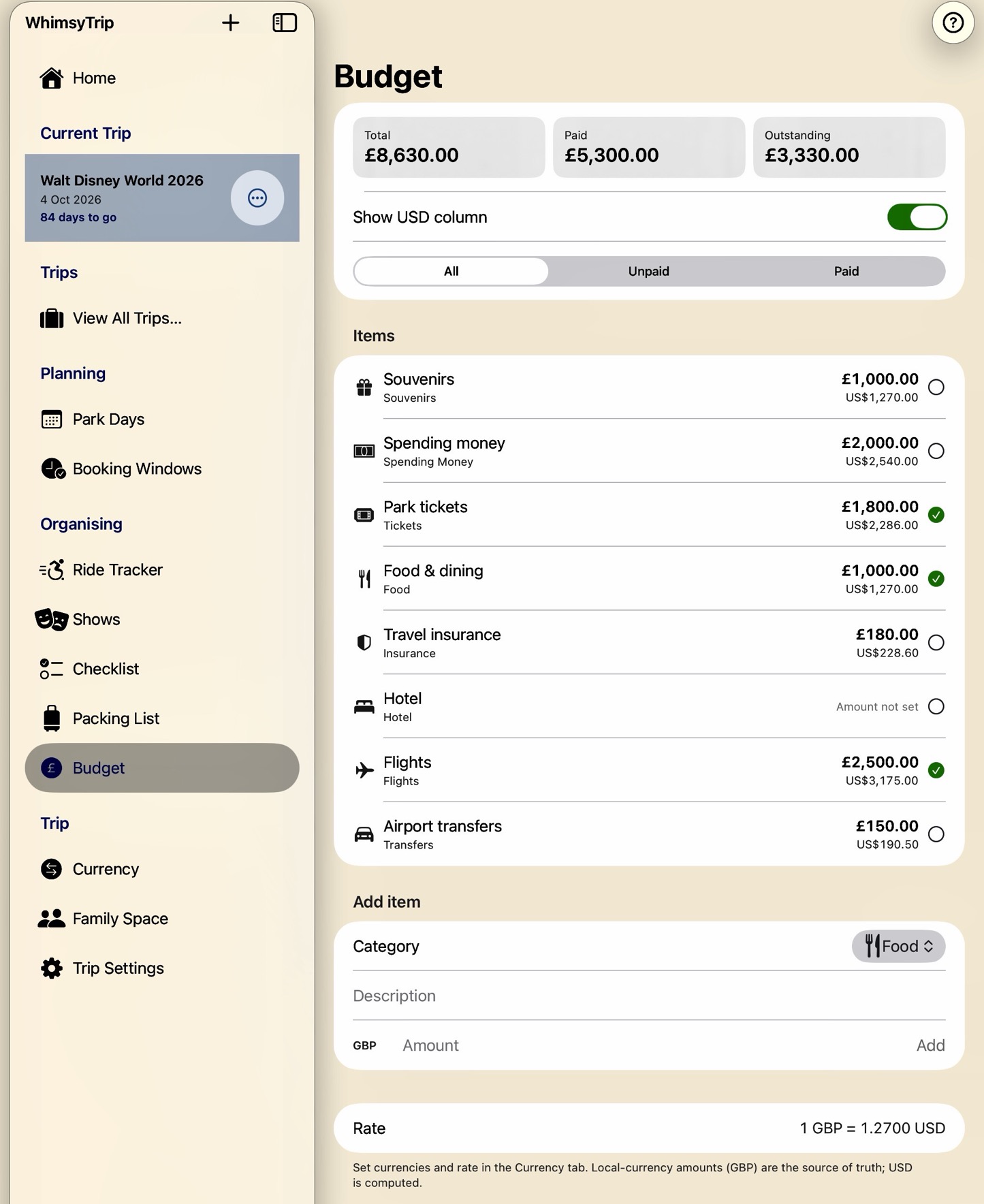
For UK families, tips are worth thinking about early. Table-service meals can be brilliant, and the service is often excellent, but the expected tip can sting if you have not built it into the budget. Quick-service meals are usually easier on the budget and do not carry the same tipping expectation.
A sensible split for some families might be roughly 20% table service and 80% quick service or off-site meals. That is not a rule. It is a way of asking whether every meal needs to be a big sit-down experience.
Budget should also help answer:
- on-site or off-site
- package or self-built trip
- Disney only or Disney plus Universal
- hire car or no hire car
- table service or mostly quick service
- how many rest days
- whether extras are worth it.
There is no moral victory in spending more. The best trip is the one your family can afford and enjoy.
Use trusted sources, but do not let them take over
There is excellent Disney planning advice online, and some channels we have found useful include:
Different sources are good for different things: videos can explain the feel of a resort or park day, blogs can be handy for lists and comparisons, and travel providers can show package options and real prices.
The problem is volume.
A general search will give you more advice than any normal person can process. One video leads to another. One restaurant list leads to ten more. Then you are comparing crowd calendars, room categories, snack credits that may no longer exist, and ride strategies from three Disney rule changes ago.
Use research to answer one decision at a time. Weather research should help you choose a month. Hotel research should help you understand on-site vs off-site. Ticket research should help you decide what parks you are likely to visit.
Once a source has helped you make the decision you came for, stop. Do not keep researching because you feel you are supposed to.
Use AI carefully
AI can be useful at the research stage if you give it a clear job.
For example, instead of asking, “Plan my Disney holiday,” give it your constraints:
- UK family of four
- school-age children
- two-week trip
- travelling in October
- considering off-site accommodation
- budget-conscious
- wants Disney and maybe Universal
- needs rest days.
Then ask it to compare options, list trade-offs, or suggest questions you still need to answer.
Do not let AI make the decision for you. Use it like a planning assistant that helps you weigh things up. The final answer still needs to fit your family, your money, and your tolerance for heat, walking, queues, early mornings, and theme-park chaos.
Think about travel documents early
ESTA belongs in the research and booking conversation, not the night before you fly.
UK travellers need valid passports and approved travel authorisation before travelling to the United States. The exact rules can change, so check the official U.S. Customs and Border Protection ESTA site at https://esta.cbp.dhs.gov and current UK travel guidance before relying on anything you read in a planning blog.
The practical point is simple: do not treat documents as an afterthought.
Add early reminders for:
- passport checks
- ESTA
- travel insurance
- medication
- driving licence if hiring a car
- ID for age-restricted purchases
- names matching booking documents.
It is less glamorous than picking restaurants, but it matters rather more at the airport.
What first-timers usually worry about
Most first-timers worry about two things: cost and being overwhelmed.
Both are fair.
Disney World is expensive, especially from the UK. It is also not one park with a few rides. It is a large resort area with multiple theme parks, water parks, hotels, transport options, dining rules, ride access products, app-based planning, and a language of its own.
You do not need to understand all of it on day one.
At the research stage, your aim is only to make the big choices: when to go, roughly what to spend, where to stay, which parks to include, how intense the trip should be, and what the family wants from it.
Everything else can come later.
Research checklist
Before moving to the booking stage, try to answer these once:
- Which dates or months are realistic?
- Are school holidays part of the plan?
- What weather are you comfortable with?
- What is the rough budget, including food, spending money, tips, transport, documents, and insurance?
- Are you leaning on-site or off-site?
- Are you looking at package holidays or building the trip yourself?
- Is this Disney only, or Disney plus Universal and other Orlando days?
- How many rest days might you need?
- What does each person most want from the trip?
- Have you checked passport and ESTA requirements?
You do not need perfect answers. You just need enough clarity to stop researching everything and start booking the foundations.