
Stage 3 · Plan
How to Plan Disney Park Days That Actually Work
Turn booked dates and tickets into park days that suit your family, your feet, your budget, and your energy.
Once the trip is booked, it is tempting to start filling every gap. That is how Disney plans become exhausting before anyone has even packed. A good park plan is not a military timetable. It is a practical shape for the holiday: where you are going, what matters most, where the rest sits, and what can move if the day changes.
The aim is to build days your family can actually enjoy, not to do everything.
Start with arrival and departure days
Arrival and departure days need softer expectations. If you are flying from the UK, the first evening can be odd. Everyone is excited, tired, hungry at strange times, and not quite sure whether it is bedtime or breakfast. A full park evening can work for some families, but it can also start the trip with everyone running on fumes.
Consider arrival-day plans like:
- checking in without rushing
- a supermarket stop
- a simple meal
- a swim
- Disney Springs
- a resort wander
- or an early night so the first full park day starts well.
Departure day also deserves respect. Packing, checkout, airport timings, car return, luggage, and tired children can eat more time than expected.
Check likely quieter park days before fixing the order
Some parks are often quieter on certain days than others, so it is worth doing a quick web or YouTube search before fixing your park order. Treat that research as guidance rather than law. Events, holidays, weather, ride closures, party nights, early entry, ticket offers, and Disney changes can all shift the pattern. If you are staying at a Disney resort, also check whether your stay includes early theme park entry. Deluxe Disney resort guests may also get extended evening hours on selected nights. Those perks can change the best order for your park days, but early entry is only really useful if you are prepared to arrive properly early. For a 7am opening, that can mean bracing yourselves for being at the park before 7, not wandering out of the hotel at 7.
Rob at Ear Scouts explains this sort of timing well, especially for families trying to understand whether early starts are worth it.
The useful question is not, “What is the perfect day for Magic Kingdom?”. It is, “Is there an obvious day I should avoid, or a day that gives us a better chance?”. A few minutes of research here can save you from putting the busiest park on the hardest day of the trip.
Build in resort time and breaks from the parks
Rest is part of the plan, not a failure of the plan. On our trips, we have averaged somewhere between 4 and 10 miles of walking a day. Even if everyone is having a lovely time, sore feet can change the mood of the whole family quickly.
For most families, especially from the UK, it helps to plan breaks before anyone needs them. That might mean a pool afternoon, a later start, a resort breakfast, a shopping morning, or a day where you do not enter a park at all.
If you are staying at a Disney hotel, check the current water park benefit before you travel. At the time of writing, Disney is offering eligible Disney Resorts Collection hotel guests water park access on check-in day for arrivals from 26 May to 8 September 2026, and has announced the benefit will return in summer 2027 with dates still to be confirmed. If it applies to your booking, it could be a gentle way to start the trip and begin getting over the jet lag. Do check the current Disney offer page before relying on it, because eligibility and dates change.
Use non-park time properly
Non-park time is not wasted time. The outlets can be good for bargains, especially if shopping is already part of your Orlando plan. Disney Springs can also work well as a lower-pressure day or evening, with shops, entertainment, and some excellent food without committing to a full park day.
These days are useful pressure valves. They give people time to sleep, swim, shop, eat properly, do laundry, recover their feet, and remember that the holiday is meant to feel good.
Place the hardest park days carefully
Some days take more out of people than others. Magic Kingdom can be emotional, busy, and full of must-dos. EPCOT can involve a lot of walking. Animal Kingdom can feel hotter because of the paths and shade pattern. Hollywood Studios can become a ride-priority puzzle if your family cares about Star Wars, Toy Story, Tower of Terror, or shows. Universal days can also be big days, especially if you are moving between parks or trying to fit in the headline rides.
Avoid stacking every hard day together. A heavy park day followed by another heavy park day followed by an early dining reservation can look efficient on paper and feel brutal in real life.
Think morning, afternoon, and evening
A whole-day label is often too blunt. A day might start in one park, slow down in the afternoon, then finish somewhere else for food or fireworks. Or it might be a morning park day, a pool afternoon, and an early night.
Thinking in morning, afternoon, and evening blocks makes the plan easier to adjust. It also helps when the family wants different things from the same day.
A simple day shape might be:
- morning: main rides while everyone has energy
- afternoon: lunch, pool, nap, shopping, or a lower-pressure park
- evening: meal, fireworks, show, or a slower wander.
That is often more useful than writing “Magic Kingdom” across the whole day and hoping everyone copes.
Build a family wishlist before the plan gets crowded
The wishlist belongs in the planning stage. Before booking windows and park days force decisions, ask everyone what they care about. Rides, shows, characters, parades, fireworks, snacks, restaurants, shops, pools, resort time, and quiet time all count. This gives quieter people a voice, and it stops one person accidentally designing the whole trip around their own priorities.
For each person, capture:
- must-do rides
- must-see shows
- food they really want
- things they are nervous about
- anything they would happily skip
- one thing that would make the trip feel special.
Separate must-dos from nice-to-dos
A Disney plan gets messy when everything is treated as essential. Be honest about the difference between must-do, nice-to-do, and only-if-it-fits. That does not make the trip less magical. It makes it less fragile. If five things really matter on a day, plan around those five. If twenty things are marked as essential, the plan will start lying to you.
Add meals and travel time
Meals and transport are easy to underestimate. A restaurant booking is not just the meal time. It is travel to the restaurant, checking in, waiting, eating, paying, and getting back to whatever comes next. Moving between parks, resorts, car parks, buses, boats, monorails, skyliner routes, rideshares, and security checks can take longer than expected. If you put meals into the plan early, you can see whether the day still makes sense.
Leave space for changes
The plan should help the day, not boss the family around. Weather changes. Queues change. Someone gets tired. A child spots something they love. A ride goes down. A show time moves. A meal takes longer than expected. Someone’s shoes betray them at 2pm.
Build a plan with enough shape to guide you and enough slack to survive contact with real life.
Where WhimsyTrip helps
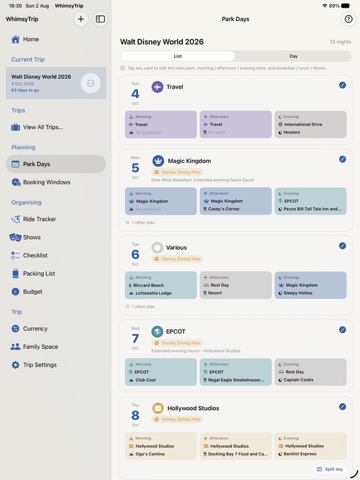
This is one of WhimsyTrip’s strongest fits. Park Days can hold all-day plans, split days, Resort and Travel days, meal plans, notes, and shared changes. Ride Tracker and Shows can hold family favourites before the trip, then help you tick them off when you are there. The plan is not trapped in one person’s head, one spreadsheet, or a message thread. Everyone can see the shape of the trip, and the details can change without losing the original thinking.
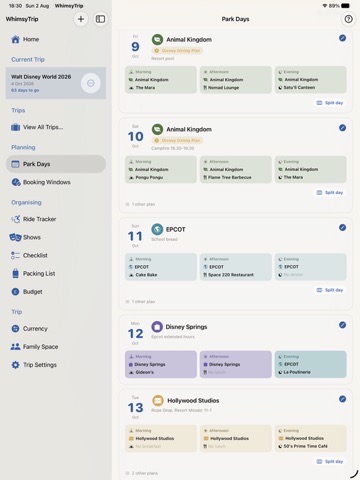
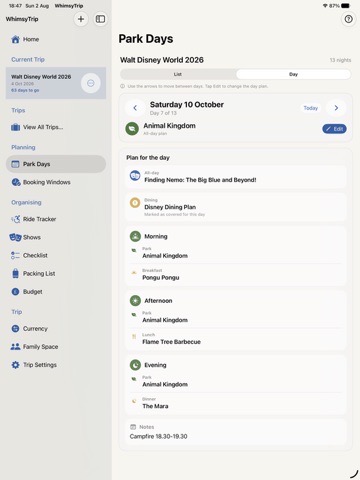
The list view gives you the whole trip shape at a glance, which is useful before you travel. You can see the harder park days, quieter resort blocks, Disney Springs time, travel days, meals, and extra plans in one place instead of flicking between notes. Day view then focuses on the day you are actually planning or living through, with arrows to move through the trip and a single timeline for that day’s parks, meals, notes, and other plans.
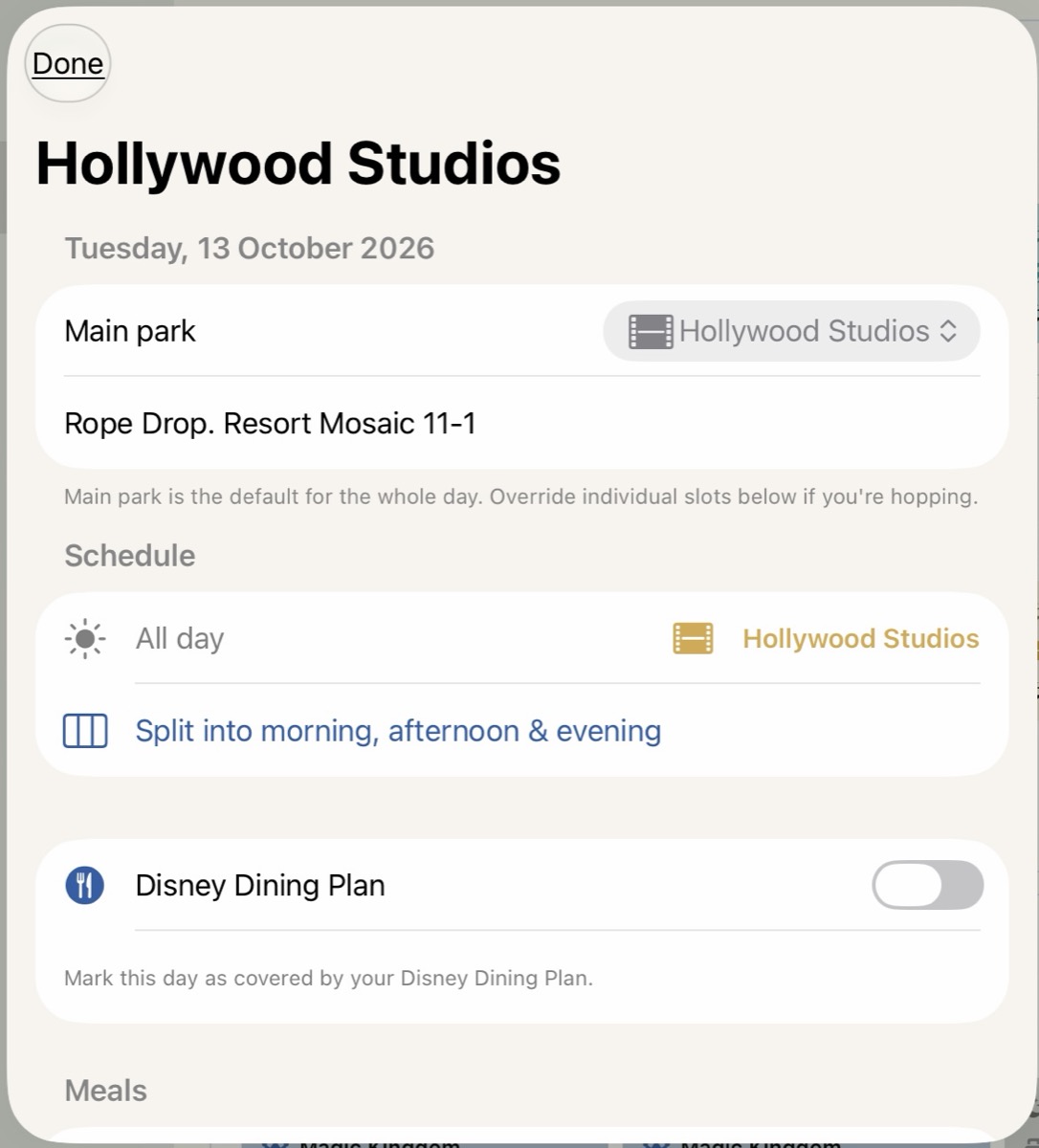
When a day needs more detail, you can open it and decide whether it stays as one all-day plan or splits into morning, afternoon, and evening.
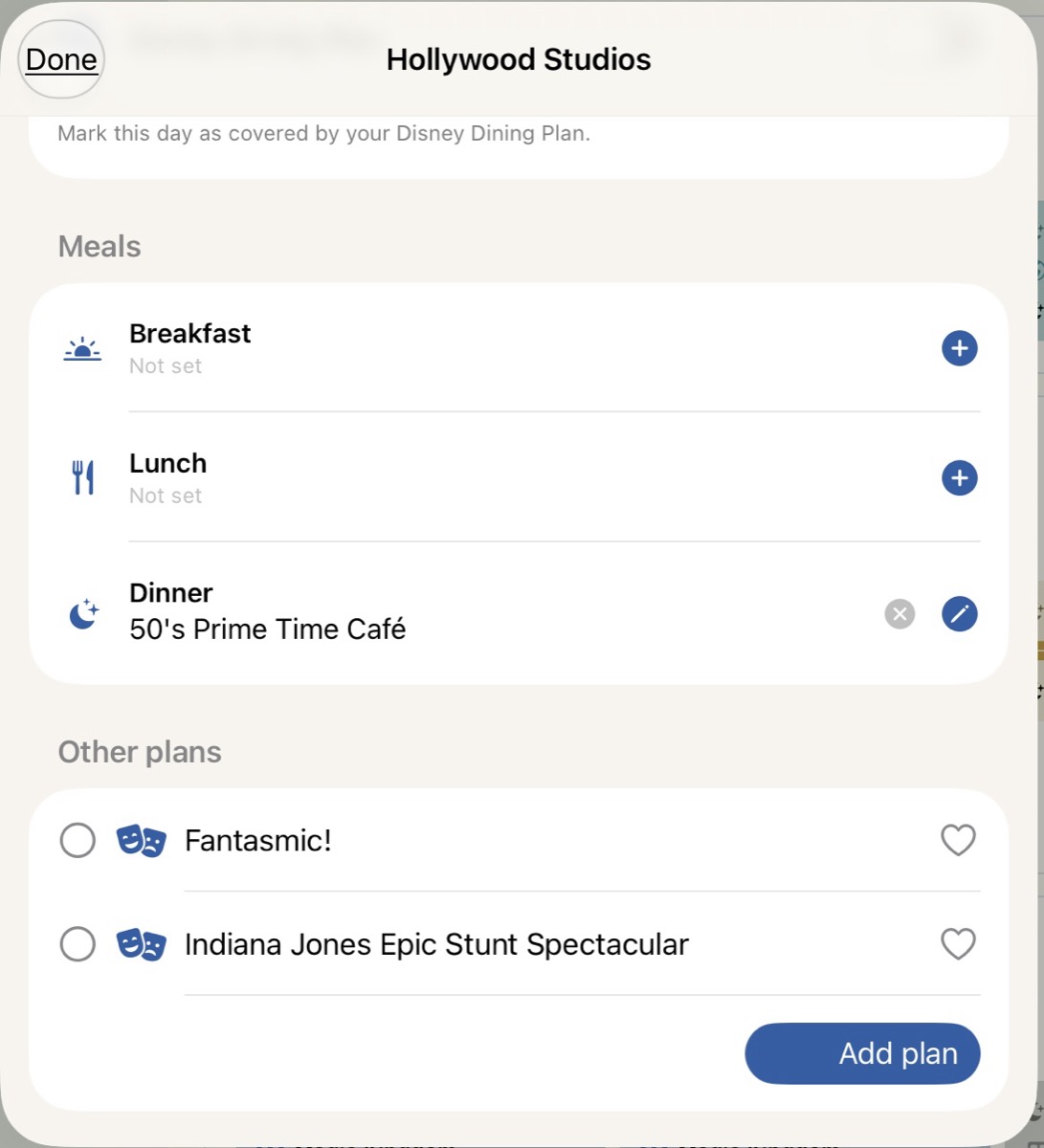
That split is where the planning becomes more realistic. A day can be Magic Kingdom in the morning, a resort break in the afternoon, and Hollywood Studios in the evening. Breakfast, lunch, and dinner sit with the part of the day they affect, and notes can hold the human detail: rope drop plans, booking references, family reminders, or anything that would otherwise disappear into a group chat. If you use the Disney Dining Plan, you can mark the day so it is visible alongside the meals.
Other plans give the day room for the things that do not fit neatly into “park” or “meal”: shows, rides, shopping, breaks, travel, and family must-dos. You can favourite the things that matter, tick them off later, and still keep the day readable.
Park day planning checklist
Before moving on to restaurant and extras reservations, try to have these answered:
- Which days are park days?
- Which days are rest, resort, shopping, or Disney Springs days?
- Have you checked likely quieter days before fixing park order?
- Have you avoided stacking too many hard days together?
- Have you allowed for 4 to 10 miles of walking on busy days?
- Have you checked whether water park arrival-day access applies?
- Does each person have a few must-dos captured?
- Are meals and travel time included?
- Is there enough room for the plan to change?
Once the days have a sensible shape, the next stage is preparing for the booking windows: restaurants, extras, time zones, backup choices, and the moments you do not want to miss.